Parenting
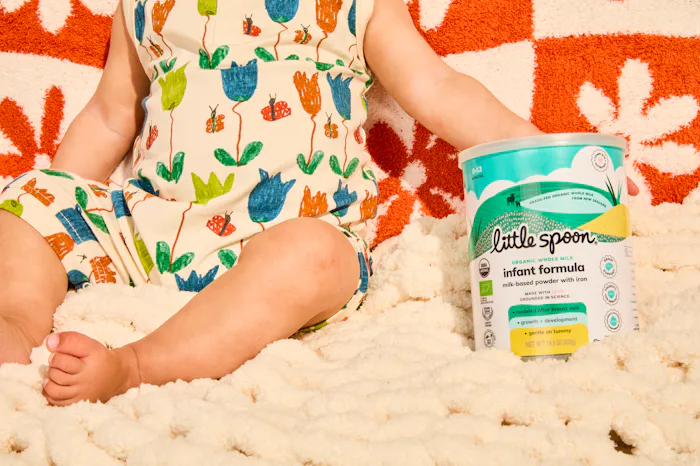
Everything You Should Know About The Infant Formula That Goes Further In Nutrition, Safety, & Transparency
Little Spoon is a formula that shows its work.
Feeding a baby sounds simple — until you're the one doing it at 3 a.m., squinting at an ingredient list and wondering what half of it actually means. Somewhere between the late-night feedings and the group chats and the rabbit holes, choosing a formula can start to feel like a much bigger decision than anyone warned you about.
And honestly? It kind of is.
Every infant formula on the shelf is designed to support your baby's growth — that part is non-negotiable and FDA-regulated. But once you start comparing options side by side, the differences get harder to ignore. Questions about knowing where the milk comes from, what's added in (and what isn't), and how much a brand is actually willing to tell you about what's behind the label may start swirling around your mind during those late-night feeds.
That's a big reason why it’s worth taking a closer look at Little Spoon's Organic Whole Milk Infant Formula — a formula built to go further in three areas that matter most: nutrition, safety, and transparency.
Here's what that actually looks like in practice.
It Starts With The Milk — & That Choice Shapes Everything

Every formula has to deliver complete nutrition. What separates them is how that nutrition is built from the ground up.
Little Spoon starts with organic grass fed whole milk from New Zealand, where cows graze on open pasture for 350+ days a year — well above the USDA organic minimum of 120 days. That extra time outdoors, eating far more grass than cows in typical grain-fed dairy operations, lays a clean, nutritious foundation from the very first ingredient.
Using whole milk keeps the natural fat profile intact, requiring less added oils to achieve the balance of fatty acids that babies need — and that choice carries through the rest of the formula. Omega-6 levels land within the range typically found in breast milk, which most premium formulas don't actually achieve. MFGM, a component of breast milk linked to early development, is naturally present in the Little Spoon Organic Whole Milk Infant Formula because it lives in whole milk fat — it was never stripped out, so it doesn't need to be added back in. And lactose is the primary carbohydrate, with a 60:40 whey-to-casein ratio that mirrors what babies get when they nurse.
The formula is also USDA Organic and EU Organic certified, and made without corn syrup solids, palm oil, soy, or maltodextrin.

What Little Spoon Builds In (That Most Formulas Leave Out)
Beyond the milk itself, Little Spoon adds a handful of ingredients found in breast milk that a lot of formulas skip.
The first is a full set of all five nucleotides — the building blocks of DNA and RNA that breast milk delivers in abundance, but cow's milk doesn't. They support immune development, gut health, and stronger antibody responses to vaccines. Paired with them is a prebiotic called FOS, a fiber that feeds the beneficial gut bacteria common in breastfed babies.
Little Spoon also includes L-Carnitine, which helps babies turn fat into energy — something they can't make enough of on their own in the first year. It's required in EU formula standards but missing from some U.S. options. The formula also contains DHA and ARA at levels consistent with breast milk to support brain and eye development.
Safety That Goes Beyond The Baseline
Infant formula is already one of the most regulated food categories in the country, which is worth noting, because the headlines don't always reflect that.
"To the parents that are out there — the sky is not falling," says Dr. Kathleen (Kathy) Glass, Ph.D., a leading food safety expert who spent nearly four decades at the University of Wisconsin–Madison's Food Research Institute. "The infant formula is a very safe product, and parents should be confident that the industry in general is doing a very good job."
That said, how individual brands approach testing still varies a lot. Little Spoon tests every batch across six categories (heavy metals, pathogens, toxin-producing and spore-forming bacteria, hygiene indicators, pesticides and glyphosate, and plasticizers) for more than 500 potential contaminants, including heavy metals, pathogens like Cronobacter and Salmonella, toxin-producing bacteria, hygiene indicators, pesticides and glyphosate, and plasticizers. Little Spoon’s internal thresholds meet or exceed FDA requirements, and any batch that doesn't meet every threshold simply isn't released. The formula has also earned the Clean Label Project's Purity Award, Pesticide-Free certification, and the First 1,000 Days Promise Award — making it one of only two formula brands to hold that last distinction.


Transparency You Can Actually See
Here's the part that genuinely sets Little Spoon apart: they publicly publish their batch-level testing results, including actual numbers for heavy metals, not vague pass/fail summaries.
That means instead of taking a brand's word for it, you can see the data behind the batch in your kitchen — and the safety thresholds it was measured against. In a category that runs on trust, that kind of openness is still rare.
"If I were a parent, I would be choosing a brand that would be transparent with what they are doing to make that food product safe," Dr. Glass says. "Because transparency helps to build trust… I want to know that they aren't just testing for testing's sake, but they really do have a passion for the safety of their consumers and for the infants."
The Bottom Line
There's no single "right" formula for every family, but understanding what sets options apart — from where the milk comes from to what's added in to how much a brand is willing to share — can make a hard decision feel a lot more manageable.
And when you're feeding your baby multiple times a day, often in the most exhausting, vulnerable stretches of new parenthood, having clearer information in your hands is the thing that tends to make the biggest difference.
