Contributor Content
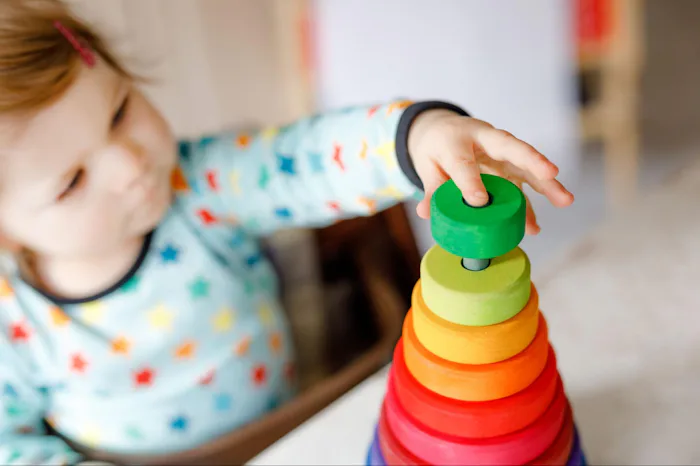
How To Pick Toys That Support Your Baby's Development, Stage By Stage
From reaching for a toy to taking first steps, babies explore familiar playthings in new ways as their abilities change.
The baby toy aisle can be a lot. Here, you can find toys for tummy time, toys for teething, toys for sensory play, toys that light up, toys that play music and toys that promise to help with anything from fine motor skills to creating future geniuses.
It's enough to make you wonder: does your baby really need all of this?
The good news is that babies don’t need to have a perfectly organized playroom. They’re curious about the world around them. To a baby, almost anything is a toy. A scarf is fascinating. So is a wooden spoon, a soft pillow, a cardboard box or a hairbrush. Give a baby something new to touch, gaze at, shake, move or figure out and you’ve undoubtedly given them something worth exploring.
This doesn’t mean that toys are unhelpful. Some toys give babies the chance to practice abilities as they develop. When you are choosing toys for your baby, pay attention to what your baby is beginning to do instead of relying on the claims the product makes about developmental milestones.
Babies learn through their senses. Touching different textures, listening to sounds, putting items in their mouth or tracking items with their eyes. Encouraging these everyday experiences and activities may support language, coordination and motor development
Development doesn’t follow an exact timetable, either. One baby may sit independently at five months while another gets there later. The point isn't to race toward the next milestone. It's to give your baby opportunities to practice the skills they're already starting to discover.
On Their Back: Discovering Their Own Body
Babies can get pretty absorbed in their own hands during those first few months. They stare at their fingers, wave their arms around and kick their legs, sometimes with no apparent reason for doing any of it. A familiar voice might get them to turn their head, or they'll follow a toy with their eyes until it moves out of sight.
You can move a toy slowly in front of your baby or give them a soft cloth to feel while they're lying on their back. Sometimes they'll be more interested in watching your face while you talk to them. That's fine, too.
An open-design ball can be useful at this stage, too. Its design makes it easier for small hands to grab, hold, and eventually transfer from one hand to the other. Many versions also make a gentle sound when moved, adding another sensory element.
Sitting Up: Reaching, Grabbing, And Figuring Things Out
As soon as your baby can sit up on their own, play will look a little different. They're no longer experiencing everything from their back. They can reach out and touch things from different angles, turn their bodies, grab things and bring them closer, and start to learn what happens when they move different things around.
Put a few interesting objects within reach, but not all directly in front of them. When they reach slightly to one side or turn to grab something, it helps them practice moving their bodies and shifting their weight.
Also, this is a good time for books with thick board covers. Reading to babies while letting them grab, pat, and eventually turn the pages is a way to work on their coordination skills.
Instead of being read, the book might more often get chewed on. That's part of the process.
Crawling: Give Them Somewhere To Go
Once babies start getting up on their hands and knees, they may start trying to reach for things that didn’t interest them before.
Try putting a toy a short distance away and see what happens. Your baby might rock back and forth, stretch toward it or manage to move forward a little. If they're getting frustrated, bring it closer. You can even get down on the floor and crawl a few feet away to see whether they'll follow you.
Pulling Up, Standing, And Taking Those First Steps
Eventually, your baby will outgrow just crawling on the floor. Babies start grabbing onto furniture and pulling themselves upright. Pulling up and standing can give babies the opportunity to practice putting weight on their legs, shifting from one foot to the other, and figuring out what happens when they let go.
And then come those first steps. Most babies spend plenty of time in between. They may stand for a second, sit back down, cruise along furniture, take one wobbly step and immediately grab something again. It can look like they're almost walking for weeks before they actually decide to commit.
That's normal. Walking is not a switch that suddenly flips. It's a collection of smaller skills coming together.
Balance Is A Skill, Too
Once babies start standing and walking, balance doesn’t necessarily follow immediately. In reality, they're still learning how to control their weight, recover when they wobble, and coordinate their feet with the rest of their bodies.
That's why the kind of support they use matters.
A toy with 3 or 4 wheels may help a new walker move around, but it doesn't give them an opportunity to practice controlling their own balance because the toy itself remains stable on its own. A toy that allows the child to respond to their own shifting weight is much better for their balance development.
This is where a lightweight, two-wheel balance toy can become interesting. With a parent's support nearby, a baby can experiment with walking while also feeling how their body moves from side to side.
The Strider Baby Balance Bike is designed specifically for this early age. It weighs only 2.4 pounds and has two wheels, allowing young children to move it without having to manage the overwhelming weight of a heavier ride-on toy. It's also meant for earlier developmental phases with wheels that feature raised letters, numbers, and shapes, giving babies something to explore during tummy time, long before they're ready to ride.
The idea isn't to rush a baby toward biking. It's simply another way to give them something they can touch, move, and eventually learn to control as their balance and coordination develop.
Let Them Explore
The funny thing about watching a baby develop is that the things that look insignificant to adults can be a pretty big deal to a baby.
Picking up the same object 20 times is practice. Dropping something from the high chair and watching you retrieve it is an experiment. Turning a wheel, flipping a page, crawling three feet across the floor, or standing for two seconds longer than yesterday all give a baby information about how their body and their environment work.
That’s why you don't need to constantly replace toys as your baby grows. The same object can become interesting in different ways as their abilities change.
A ball that was once fun to look at becomes something fun to grab. Then something to roll. Then something to chase.
The toy doesn’t change. What changes is how your baby plays.
Before You Know It
The stages can feel slow in the moment but fast once you look back.
One day you're putting a toy just within reach during tummy time. A few months later, you're chasing a baby down the hallway. Eventually, you're watching them figure out how to balance, steer, and move on their own (and maybe, someday, watching them line up for a Strider Cup race!).
You don’t need to track every new talent. Give your baby space to explore. Get down on the floor with them, then give them a chance to take control. At first, your baby might depend on you for all of their fun, but once they find out that they can poke, pull, stack, shake, drop, and inspect items on their own, you can step back and watch. Your presence gives them the security to explore, and calm observation allows you to see how much they’re figuring out on their own.
And you don't necessarily need to keep buying new toys to keep that discovery going. Sometimes the most interesting thing to a baby is the toy they've already had for months, because they're suddenly old enough to use it in a completely different way.
This article is for informational purposes only and does not substitute for professional medical advice. If you are seeking medical advice, diagnosis or treatment, please consult a medical professional or healthcare provider.
BDG Media newsroom and editorial staff were not involved in the creation of this content.
