Parenting
Why Parents Are Paying Closer Attention To Kids’ Group Chats
Sage Haven CEO Kate Doerksen says group chats can expose children to online risks earlier than many families expect.
For many parents, a child's first phone feels like a milestone. It offers independence, connection, and peace of mind. But according to Kate Doerksen, CEO and co-founder of Sage Haven, the biggest risks facing children online aren't always found on social media. They're often happening inside group chats.
"Group chats are the new schoolyard," says Doerksen. "The difference is they run 24 hours a day, seven days a week, with no teacher walking by."
As children get their hands on watches, tablets and phones at earlier and earlier ages, group chat is becoming one of the most important ways for children to communicate. Yet, Doerksen explains, many parents are unaware that inside the secrecy of these personal conversations, children are often involved in harmful activities
Cyberbullying, exclusions, crude jokes and even sharing of naked photos often occur in the privacy of these conversations, remaining hidden from prying eyes.
"Kids feel a false sense of security behind screens so the bullying tends to intensify," Doerksen explains.
Perhaps most concerning, children who are struggling often remain silent. They may feel embarrassed, worry about losing access to their devices, or simply not know how to ask for help.
Children Are Being Exposed Earlier Than Parents Think

One of the biggest surprises Doerksen has encountered through her work is just how young children are when they first encounter inappropriate content.
"We assumed most issues would involve older tweens," she says. "Instead, we're seeing explicit images and links being shared among children as young as eight and nine years old."
Often, it isn't that children are searching for these things on the internet; it's more that they're passed along by word of mouth, from child to child, not really knowing what they're getting into.
One message can reach many children and cause great distress.
That's one reason Doerksen believes messaging deserves more attention from parents than it currently receives.
Why Traditional Parental Controls Aren't Enough
Many parents rely on screen-time limits or app restrictions to keep their children safe online. While those tools can be helpful, Doerksen says they often leave a significant blind spot when it comes to messaging.
Traditionally, parents who want insight into their child's conversations have only one option: manually scrolling through messages and hoping they don't miss something important.
"This is another burden on parents and is incredibly time inefficient and clunky," she says.
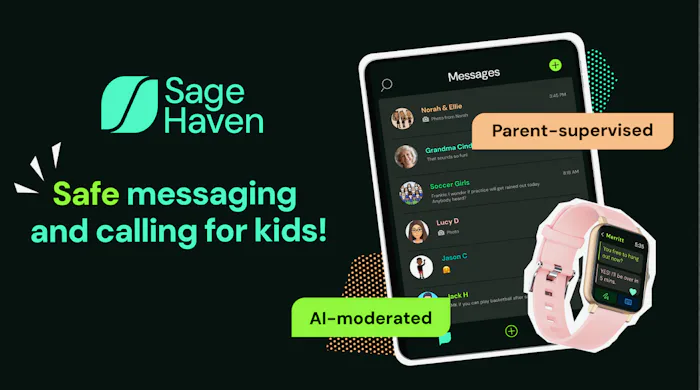
Sage Haven was designed to solve that challenge by helping parents stay informed without requiring them to inspect every conversation. The platform provides alerts and summaries that surface potential concerns before they become larger problems.
Designed With A Preventative Approach In Mind.
Some harmful messages can be blocked before they're sent, while children receive prompts that encourage kinder and more thoughtful communication.
"The interpersonal dynamics and nuances of messaging online are like everything else — they need to be taught," Doerksen says. "Today, we just throw our kids in the deep end and hope for the best."
The Case For A Slower Introduction To Technology
In a world where many children receive smartphones before middle school, Doerksen encourages parents to think differently about technology access.
Rather than handing over a device with full functionality, she recommends a gradual approach.
That might mean starting with a watch or tablet that allows communication only with immediate family members. As children demonstrate responsibility, parents can slowly expand their contact lists and introduce additional features.
"Just because you grant some technology access doesn’t mean the kid should have access to everything," she says.
This measured approach can help reduce exposure to social media, unrestricted internet browsing, AI chatbots, and other digital experiences children may not yet be ready to navigate independently.
Parents often assume these restrictions are difficult to implement, but Doerksen says parental controls have improved dramatically in recent years.
"Now, it’s very realistic for parents to lock down devices and create boundaries for their kids," she says. “It takes a little effort, and there are a few tricks, but it’s totally doable even for non-tech-savvy parents."
The One Thing Every Parent Should Do Today
If parents make only one change, Doerksen's advice is simple: pay attention to messaging.
Whether through a monitoring app or regular family conversations, parents can stay more aware of who their children are communicating with and help them understand the risks of interacting with strangers online, including through video games.
The Key, She Says, Is Transparency.
Parents can frame supervision as a matter of safety, education, and helping children build healthy communication habits, rather than as punishment or an invasion of privacy.
“We teach parents that this should be an upfront conversation with their child, including explaining the ‘why’ behind keeping them safe and helping them learn how to communicate well online,” Doerksen says.
What Comes Next

Looking ahead, Doerksen worries that technology is advancing faster than the protections designed to safeguard children.
Artificial intelligence, in particular, presents new challenges. Many AI platforms still provide access to content and experiences that parents may not realize are available to young users. From inappropriate conversations to AI-generated imagery, the digital landscape is evolving rapidly.
At the same time, she remains optimistic.
Parents are becoming more informed, schools are paying closer attention to online safety, and conversations around children's digital well-being are becoming more mainstream.
For families navigating technology for the first time, Doerksen believes the goal isn't to eliminate screens altogether. It's to stay engaged.
"The single most important thing parents can do is create a slow, safe onramp to technology access and stay involved in the first few years while kids are learning how to be safe online and use technology well."
BDG Media newsroom and editorial staff were not involved in the creation of this content.
