Life
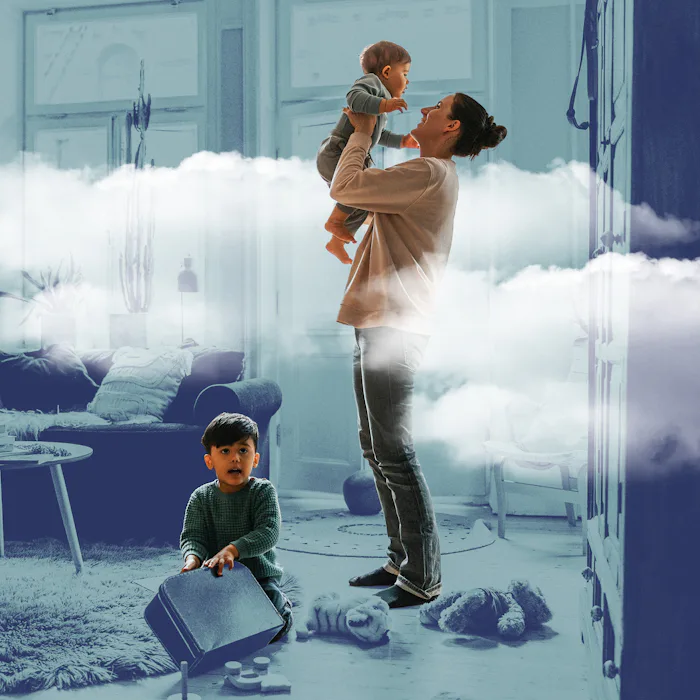
Why PPD Can Feel Different The Second Time Around
Just because you didn’t have PPD the first time doesn’t mean you’re in the clear.
Your first baby comes with a steep learning curve that can be both exhausting and exhilarating. But by the time a second arrives, you at least know what to expect. You’ve survived the sleepless nights, mastered the swaddle, and learned which baby gadgets are actually worth buying (sorry, wet wipe warmer). And if your first postpartum experience was relatively smooth, it’s only natural to assume the next one will be, too.
The reality is that postpartum depression (PPD) can show up for the first time — or look completely different — with a second or subsequent baby. I spoke with a psychiatrist and reproductive mental health specialist, as well as moms who lived through it, to understand why.
It’s More Common Than You’d Think
“Many women experience postpartum depression for the first time after a second or subsequent baby, even if they had no symptoms following an earlier pregnancy,” says Dr. Elizabeth Kern, a psychiatrist and reproductive mental health specialist in New York City. “Every pregnancy and postpartum period brings its own unique combination of biological changes and life circumstances that can influence mood. Having one symptom-free postpartum experience doesn’t necessarily mean future postpartum periods will look the same.”
This was exactly the case for Linzay in California, a mom who sailed through her first postpartum period. “After having my first baby, I remember nothing but pure bliss,” she says. She even brought her daughter along to a therapy appointment weeks later, just to share the good news. “My therapist told me she was so happy for me and that it’s not often she works with patients who feel as good as I was.”
Then came her second baby, and this time her postpartum experience could not have been more different.
When PPD Doesn’t Look Like What You Expected
After another emergent C-section — a delivery she’d hoped to avoid — Linzay felt devastated. The hospital days were OK, but once she got home, the intrusive thoughts were relentless. “I didn’t bond with my second daughter the way I did with my first. I kept imagining scenarios where I would have to choose between my children, and I always would choose my toddler. I didn’t even know this other new baby.”
And yet PPD never crossed her mind. Because she hadn’t experienced it with her first child, she assumed her feelings were the physical toll of recovery, lingering fatigue, or just the adjustment of balancing a toddler and a newborn. It wasn’t until her six-week appointment — when she cried through the entire visit — that her doctor suggested she might be experiencing PPD and postpartum anxiety. “The moment she said it, I felt validated and hopeful that I wouldn’t have to feel like this forever.”
Jillian, a mom of two in New Jersey, had a similar experience of not being able to name what she was going through. “Going from one to two children was a big transition,” she says, “and it was difficult to discern what was ‘normal’ hard versus ‘postpartum’ hard.” She’d assumed PPD would be easier to identify. It wasn’t.
What these moms experienced is not uncommon, says Kern. “With a second or subsequent baby, a mother is bringing her newborn home to a busy family with competing demands. She may not have the time, space, or emotional bandwidth to recognize some of the more classic symptoms of depression.” Instead, PPD may show up as irritability, anger, emotional numbness, guilt, or difficulty bonding — things that are easy to chalk up to the chaos of having multiple kids.
The Risk Doesn’t Go Away Just Because It Didn’t Happen Before
Many parents assume that if they didn’t experience PPD the first time around, they won’t experience it after a later birth. But that’s not how postpartum mental health works.
“While it’s true that a prior episode of PPD is the strongest known risk factor for experiencing it again, the absence of PPD after a previous pregnancy does not guarantee it won’t occur after a subsequent one,” says Kern. “Every postpartum experience carries its own level of risk. For that reason, every new mother deserves the same careful attention to her mental health, regardless of how smoothly a previous postpartum experience may have gone.”
According to Kern, there are many reasons why someone might experience PPD in subsequent pregnancies, including compounded sleep deprivation and competing demands with fewer opportunities to rest. Add to that the fact that support often tapers off with subsequent babies — fewer casseroles, fewer check-ins — and it’s easy to see why so many moms assume what they’re feeling is just stress or the demands of having two kids.
When To Reach Out For Help
“A new mother doesn’t have to wait until symptoms become severe or reach a crisis point to connect to care,” says Kern. “If she’s experiencing emotional changes that are causing ongoing distress, it’s worth reaching out for mental health support regardless of whether her symptoms fit a particular diagnosis she’s familiar with. Early intervention can make a meaningful difference.”
Partners and friends can play a crucial role here, she notes, because they “know a new mom’s baseline better than anyone else.” They’re often the first to notice something is off, and a gentle nudge toward her healthcare team can be enough to get the ball rolling.
Linzay echoes this. “I wish I had known the signs and symptoms of PPD so I could have known what to look out for. I also wish my husband had known them, too — sometimes it can be hard to see in yourself.”
Linzay’s message to any mom who’s in the thick of it right now? “Postpartum depression is extremely common — but that doesn’t make it normal. There is help, and you won’t feel like this forever.”
If you or someone you know might be experiencing PPD, Postpartum Support International offers a free and confidential 24/7 helpline and online support groups.
Presented by BDG Studios
